

“The top of the mountain is nothing without the climb”
Little Simz, Introvert
None of us start off with the same resources we need for a successful ascent. Some of us may barely step foot outside of the base camp despite our best efforts. Some of us may not even make it to the base camp.

The quote above inspired me to watch Little Simz’s video, which artistically portrays struggle and inequalities via contrasting settings; the Natural History museum, a place of high culture where people of colour are often underrepresented and/or misrepresented (Arts Council England, n.d.; Olivares & Piatak, 2022) versus shots of housing estates you would never find in This England magazine!
This video packs a powerful punch.
After reading van Nieuwerburgh & Allaho’s Coaching in Islamic Culture: Principles and Practice of Ershad, I wanted to educate myself further, to ensure I wasn’t committing some form of symbolic violence by unconsciously imposing the local dominant culture on coachees I work with.
As powerful as a transformative coaching conversation can be, coaching is still a predominantly white, middle class phenomenon, with Western-centric roots stretching back to the ancient Greeks. Nowadays, because of globalisation and the internet, we are coaching a broader spectrum of clientele.
When we think of culture, we may think of how our familial ideas, customs, and behaviours may influence our beliefs and ability to achieve goals, but Patricia Hays notes overlooked cultural influences also impact the how we show up and express ourselves in the world.
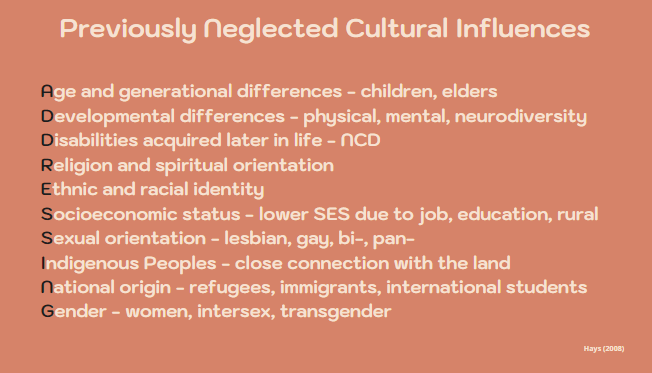
Can we effectively coach everyone to achieve their goals regardless of their cultural influences?
Ivtzan (2008) discovered self-actualisation is less easily attainable by people in collectivistic cultures; where relationship harmony and doing things for the good of the group takes precedence over personal development.
While you could argue coaching is an impartial and inclusive space aimed at empowering all humans to self-actualise and therefore cannot be biased, something didn’t sit right with me.
ICF (International Coaching Federation) only updated their coaching competencies in 2019, for the first time since 1998, so despite being international they were still operating with a Western bias (Mosteo et al., 2021).
So I decided to expand my knowledge and find answers by reading, attending webinars on diversity and inclusion delivered by notable speakers such as Aboodi Shabi and Ashana Crichton. Although, going further down the rabbit hole has just raised more questions.
While we think in coaching we are just supporting one person to get to an outcome, a peer commented it’s more like coaching the one person in front of you as well as a roomful of invisible people and factors. Because even though our families, communities, and cultures are not always with us physically, their influence on language, emotions, and even how we hold our bodies is invisible but persistent.
We all should know that diversity makes for a rich tapestry, and we must understand that all the threads of the tapestry are equal in value no matter what their color.
Maya Angelou
One book Aboodi mentioned was Coaching: Evoking excellence in others by James Flaherty which, coincidentally, I had borrowed from the library the previous week about ontological coaching; coaching a way of being.
A provoking question asked by Aboodi and which I offer for you to chew on is:
What privileges do you take for granted?
Knowing that we don’t all get an equal bash at life, how can we be better allies for each other? This great, brief talk by Melinda offers simple ways we can show up better for each other:
Keep on keeping on, go well, and be good to yourself… and others 🙂 xXx
References
Arts Council England (n.d.). Equality and diversity within the arts and cultural section of England. https://www.artscouncil.org.uk/sites/default/files/download-file/Equality_and_diversity_within_the_arts_and_cultural_sector_in_England.pdf
Hays, P.A. (2008). Addressing cultural complexities in practice: Assessment, diagnosis and therapy (2nd ed). American Psychological Association.
Ivtzan, I. (2008). Self-actualisation: For individualistic cultures only? International Journal on Humanistic Ideology, 1(2), 111-138.
Olivares, A., Piatak, J. (2022). Exhibiting Inclusion: An Examination of Race, Ethnicity, and Museum Participation. Voluntas 33, 121-133.
Mosteo, L. P., Maltbia, T. E., & Marsick, V. J. (2021). Coaching for cultural sensitivity: Content analysis applying Hofstede’s framework to a select set of the International Coach Federation’s (ICF) Core Competencies. International Coaching Psychology Review, 16(2), 51.
 Jules Sparkles